12 July 2026 · BotShark Team
The account that says the same three things to everyone
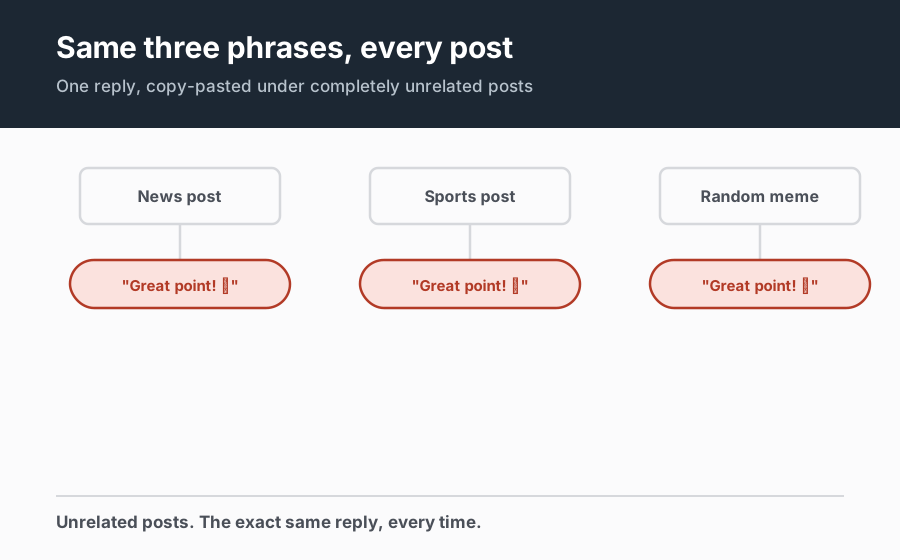
A template reply spammer drops "Great point!" / "This 100%." / "Couldn't agree more 🔥" under completely unrelated posts — clearly not reading anything before it replies.

Scroll through the replies on almost any popular post and you'll spot at least one of these: an account replying with something generic enough to fit under literally any post — "This is so true," "Great take," "Couldn't agree more" — that clearly hasn't engaged with a single word of what it's actually replying to. Now check that account's other replies, on completely different posts, about completely different topics. Same handful of phrases, recycled endlessly. This is what we call a template reply spammer, and it's one of the lowest-effort, highest-volume bot patterns out there — which, ironically, is exactly what makes it easy to catch.
What it's actually doing
There's no real content generation happening here, not even the AI-assisted kind. It's a small rotating set of generic, agreeable, content-free phrases, fired off under as many posts as possible. The "strategy," if you can call it that, is pure visibility: get a reply into as many threads as possible, as cheaply as possible, without any regard for whether the reply makes sense in context — because for this operator's purposes, it doesn't need to.
The pattern shows up as:
A high volume of generic, template-flavored reply text — the same short phrases showing up again and again across an account's reply history.
Clusters of genuinely near-identical replies, not just similar-in-spirit but close to word-for-word, scattered across unrelated posts.
Sometimes confirmed even deeper in the data — the same templated language showing up inside full conversation threads, not just in the top-level replies tab, which rules out the more charitable read that it's just a coincidence of a few similar-sounding comments.
Often paired with heavy outbound reply volume and very little coming back, since template spam is really a variant of the same reply-farm logic — visibility through volume — just executed with even less effort per reply.
Why this pattern exists at all
It's the cheapest possible version of the reply-farm playbook. Writing a genuinely relevant reply to every post takes at least a little thought, even with a script or a model behind it. Recycling three or four all-purpose phrases takes none. Academic surveys of social-bot detection consistently identify content-based spam — generic, repetitive, low-effort text posted at volume — as one of the most common and longest-studied bot behaviors on record, precisely because it's the cheapest tactic available to anyone trying to fake engagement at scale (ResearchGate, "Emotional Bots: Content-based Spammer Detection on Social Media"). Detection research going back well over a decade has built machine-learning classifiers specifically around this kind of repetitive, templated posting behavior, because unlike more sophisticated bot patterns, the sheer repetitiveness of the text itself is often enough of a signal on its own to flag an account (Springer, "Detecting Spam Bots in Online Social Networking Sites: A Machine Learning Approach").
How BotShark spots it
We look at how much of an account's reply history is generic, template-shaped text, and whether that text clusters into repeated, near-identical phrases rather than genuinely varied responses. We also check inside full conversation threads, not just the surface-level replies tab, specifically because template spam sometimes only becomes obvious once you look past the first layer of a conversation — a reply that looks plausible in isolation can turn out to be the fortieth near-identical copy once you see the pattern across the account's full history.
What to do if you spot one
Don't read a pile of generic agreement replies as real social proof. A wall of "so true!" and "great point!" under a post doesn't mean a wall of people actually read and agreed with it — it might just mean a template-spam account found the post and fired off its usual three phrases, same as it does under everything else.