11 July 2026 · BotShark Team
The account that never has an original thought (and why that's the point)
A retweet amplifier almost never says anything itself — it just pushes other people's posts, over and over, all day. Here's why that's one of the easiest bot patterns to spot once you know what you're looking at.

You've scrolled past one of these without clocking it. An account with a normal-looking name, a normal-looking photo, maybe a bio that says something vague and patriotic or vaguely inspirational. It never really says anything. It just reposts. Constantly. Forty, sixty, a hundred times a day, seven days a week, and when you scroll back through months of its history, you struggle to find more than a handful of posts that were actually written by whoever — or whatever — is running the account. This is what's known as a retweet amplifier — one of the oldest, simplest, and most common bot patterns on X.
That's not a person having a weird week. It's a specific, well-documented shape of automated account, and once you know the name for it, you start noticing it everywhere.
What it's actually doing
The job of an amplifier account is right there in the name: make something look bigger than it is. Not by writing anything persuasive, not by making an argument, not even by pretending to be a real voice in a conversation — just by hitting the repost button on the same handful of posts, links, or narratives, over and over, until the numbers underneath them look like real momentum.
Think of it less like a person and more like a speaker at a rally holding up a sign that says "THIS." It's not contributing an idea. It's contributing volume.
You'll usually notice a few things stack up together on an account like this:
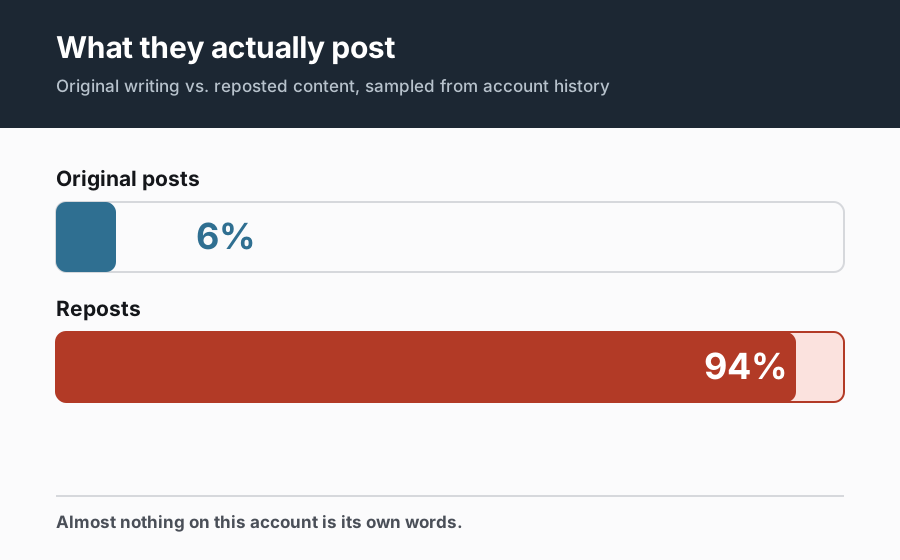
Almost nothing in its post history is original — when we say "almost nothing," we mean it, often less than one post in ten.
The volume is genuinely high. Not "posts a lot because they're chronically online," but tens of posts a day, sustained for months, which is a rough thing for one human thumb to keep up on their own.
What little text does appear alongside the reposts is often just a link, or a hashtag pile, with barely a sentence of actual opinion attached.
None of those three things alone proves much — plenty of real people repost a lot, especially around news events or things they care about. It's the combination, and the sustained volume, that starts to look less like enthusiasm and more like a job the account is doing.
Why this pattern exists at all
It comes down to something researchers at Duo Security found a few years back when they went digging through hundreds of millions of tweets looking for exactly this pattern: most normal posts get more likes than retweets, because liking something is easy and low-commitment, and retweeting takes a beat more thought. Amplifier accounts flip that ratio on its head — some of the ones they found had six retweets for every single like, which is basically the opposite of how a human timeline behaves. In one 24-hour window alone, they found more than 7,000 accounts behaving this way (Duo Security, via Infosecurity Magazine).
The reason someone builds a network of these is almost always the same: reach is expensive to earn organically and cheap to fake. If you want a hashtag to trend, a story to look bigger than it is, or a political message to seem like it has more support than it actually does, the fastest way to get there isn't convincing more real people to agree with you — it's standing up a few hundred accounts whose only job is to make the repost count climb. Researchers studying political content on the platform found that in some samples, two-thirds of the traffic pushing links to popular political sites was coming from automated accounts, not real people sharing things they'd actually read (BetaNews).
It's not always something sinister, either. Plenty of low-rent marketing operations run amplifier accounts just to make a product or an event look more popular than it is. The tactic is the same whether it's boosting a crypto token or a political talking point — manufacture the appearance of momentum, because momentum is genuinely persuasive to real humans watching from the sidelines. We follow what looks popular. That's exactly what these accounts are built to exploit.
How BotShark spots it
We're not looking at any one post and guessing. We're looking at the shape of the whole account over time — specifically, how much of what it posts is actually its own words versus someone else's, and whether the volume of that reposting is realistically something one person does by hand.
An account that reposts constantly and barely ever writes anything original and keeps that pace up day after day for months starts checking boxes that a real, busy, opinionated human just doesn't check all at once. Any single one of those is normal. All three, sustained, is the signature we're actually looking for — and it's one of the more reliable patterns to catch, because unlike some bot behaviors, it's hard to fake being less automated once the pattern's already established across months of history.
What to do if you spot one
Honestly — mostly just factor it in. If an account is amplifying a story or a stat and it fits this pattern, treat the amplification itself as close to meaningless. It's not evidence the thing being shared is true or false, popular or unpopular, just that someone wanted it to look that way. The actual claim underneath still needs to stand on its own. The retweet count next to it doesn't tell you anything once you know who's doing the retweeting.