10 July 2026 · BotShark Team
The account that talks to everyone and gets nothing back
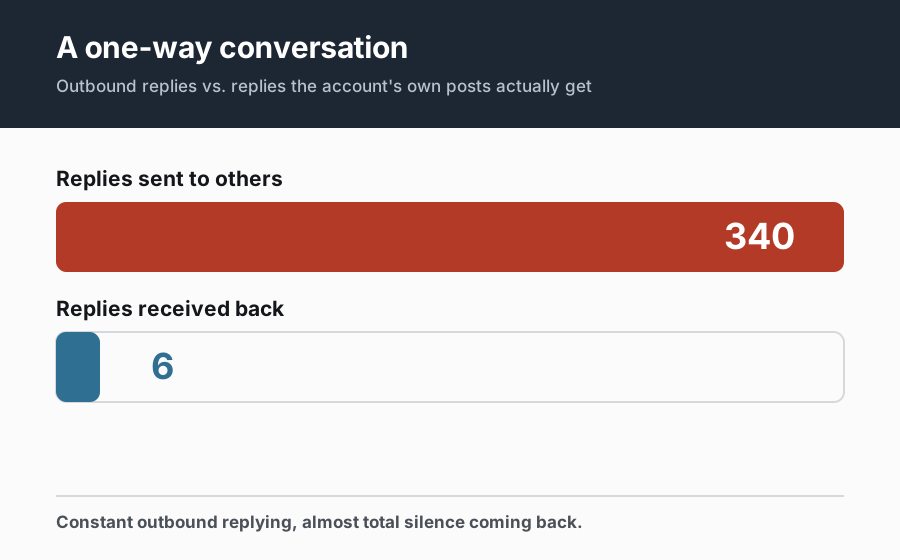
A reply farm replies constantly — dozens, sometimes hundreds of times a day — but almost nobody ever replies back. That one-way silence is the tell.

Picture a person at a party who goes around the room saying something to every single group, over and over, all night — but nobody ever really talks back to them, and if you check in an hour later, they're still doing it, to a whole new set of people. That's not a social butterfly. That's exhausting, and it's also, on X, one of the more recognizable bot patterns going: what's called a reply farm.
These accounts don't post much of their own stuff. What they do is reply. Constantly. To other people's posts, usually big accounts or trending topics, dozens or even hundreds of times a day, day after day. And if you look at their own posts — the ones they actually originate — almost nobody engages with those at all. It's a one-way fire hose of replies going out, and near silence coming back.
What it's actually doing
The point of a reply farm is visibility by volume. If you reply to enough big accounts' posts fast enough, your reply sits near the top of the thread for a little while, in front of whoever's reading that post — which might be thousands or millions of people. Do that constantly across enough posts, and you've bought yourself a lot of eyeballs without needing a single follower of your own.
The behavioral shape is pretty distinct once you're looking for it:
Reply volume that's genuinely high — not "chatty," but a large multiple of what a person could keep up typing by hand, sustained day after day.
Almost nothing coming back the other way — their own posts get few or no replies, their engagement per post barely moves even if they've built up a decent-sized following.
Often paired with being active at almost every hour of the day, because a person doing this at scale usually isn't one person on a normal sleep schedule — it's a script, a team, or an account running on a schedule.
None of these individually is damning — genuinely enthusiastic people reply a lot too. It's the lopsidedness, replies going out constantly with essentially nothing coming back, combined with volume that's hard to explain as one person's day, that starts to look like a pattern rather than a personality.
Why this pattern exists at all
This is the backbone tactic of what's often called a troll farm or reply-generating farm — accounts, often run in batches by the same operator, whose entire job is to swarm the replies under posts that matter to whoever's paying for the operation. Sometimes that's political: get a coordinated wave of hostile or supportive replies under a politician's or journalist's post so fast that it looks like organic public reaction. Sometimes it's commercial: reply-spam every post mentioning a competitor with your own product's name. Either way, the tactic works because most people reading a reply thread don't stop to check whether the replies are coming from real, independent people — they just read the vibe of the thread.
The most famous version of this operated at genuinely industrial scale: Russia's Internet Research Agency, based in St. Petersburg, reportedly ran 300 to 400 employees working in shifts specifically to generate tens of thousands of posts and replies a month, treating reply volume like a production line rather than a conversation (via Wikipedia's summary of state-sponsored propaganda operations). More recent reporting has found the same tactic still very much alive and increasingly automated — an investigation into a network of AI-powered accounts on X found them systematically spreading pro-Trump and pro-GOP replies at scale, functionally the same reply-farm playbook with a language model doing the writing instead of a shift worker (NBC News).
How BotShark spots it
We look at the ratio, not just the volume. An account can post a lot and that alone means nothing — plenty of real people are chatty. What we're checking is whether the traffic is one-directional: heavy outbound replying paired with almost no inbound engagement on the account's own posts, and whether that imbalance holds up over the account's whole history rather than being a one-off busy week. When that lopsided pattern shows up alongside signs the account rarely sleeps — active at nearly every hour, no real overnight gap — it stacks into a much stronger signal than either one alone.
What to do if you spot one
Discount the reply, not necessarily the person being replied to. A reply-farm account swarming a thread doesn't tell you anything about whether the original post is right or wrong, popular or unpopular — it tells you someone wanted that thread to look a certain way. If you're trying to gauge real public reaction to something, replies from accounts matching this pattern are close to noise, however many of them there are.