8 July 2026 · BotShark Team
The account whose replies are a little too smooth
An LLM-assisted account's replies have no typos, no slang, no stray thought — every one reads like it was written by someone who'd never typed something dumb on their phone at 11pm, because it probably wasn't a someone at all.

Real people type badly sometimes. We drop words, use slang inconsistently, get a little unhinged in a reply and then delete half of it, or just say something slightly off-topic because we misread the post we're replying to. It's not a flaw, it's just what typing quickly on a phone with an actual personality looks like.
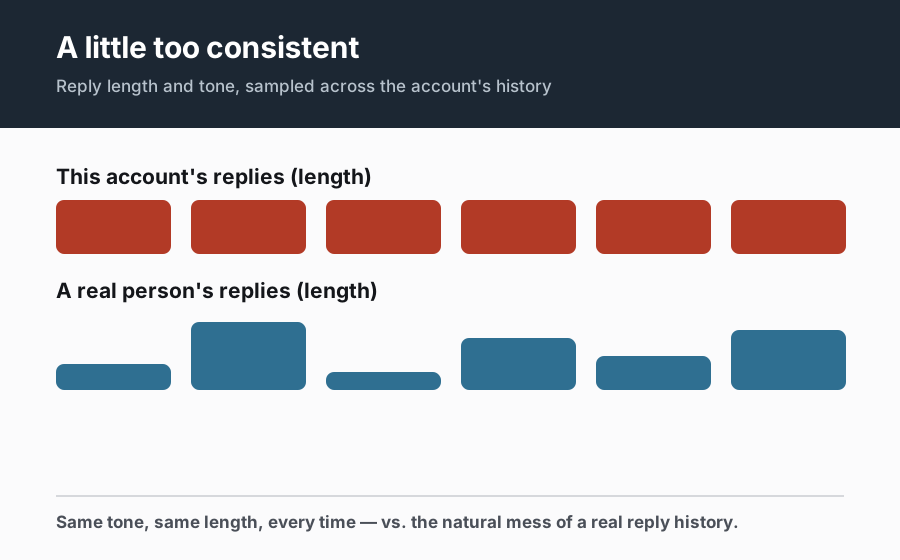
So when you find an account whose replies are all uniformly well-formed — grammatically clean, evenly toned, roughly the same length and reading level every single time, no matter what it's replying to — it starts to feel less like a person and more like something running the same process over and over. We classify this as an LLM-assisted account: replies that are AI-generated, or at least AI-polished, at scale. It's the newest pattern in the taxonomy, and it's the one that's grown the fastest.
What it's actually doing
This type isn't defined by what it says so much as how consistently it says things. A real person's reply style varies — with mood, with topic, with how much they actually care about the post they're responding to. An LLM-generated reply pipeline doesn't have moods. It has a prompt and a model, and the output tends to be smoother, more even, and more disconnected from the specific texture of whatever it's replying to than a real, distracted human tapping out a quick response.
The telltale signs cluster together:
Replies that read as polished and low-friction — no typos, no slang, none of the informal markers you'd expect from someone actually typing on their phone.
A strangely consistent emotional register across dozens of replies, when a real person's tone naturally shifts based on what they're reacting to.
Reply length and reading level that barely varies, post to post, which is unusual for a real person but exactly what you'd expect from the same generation process running repeatedly.
Replies that technically respond to a post but don't quite engage with its specifics — generic enough that the same reply could've been pasted under a dozen different posts without anyone noticing.
Why this pattern exists at all
Generating a plausible-sounding reply used to take a person, which put a real ceiling on how much reply-farming or engagement-boosting one operator could do. That ceiling is mostly gone now. A script wired up to a language model can generate hundreds of contextually-plausible replies a day without a human writing a single word, which makes this the natural evolution of the reply-farm tactic — same goal, visibility through reply volume, but with the writing outsourced to a model instead of a person or a copy-pasted template.
It's a genuinely moving target, too. Researchers tracking machine-generated text across social platforms have found it's become common enough that it shows up as a measurable share of what people are actually reading in the wild, not a rare novelty — and the arms race between generation and detection is very much still ongoing on both sides (arXiv, machine-generated text on social platforms). Investigators tracking modern propaganda operations have reached a similar, blunter conclusion: campaigns are now flooding platforms with what researchers have started calling "AI slop" — high-volume, low-quality generated content that's cheap to produce and easy to spot once you know the pattern, even though it still manages to pick up some real engagement along the way (NBC News).
How BotShark spots it
We're not trying to run a general "is this text AI-written" detector on a single post — that's a much harder and less reliable problem than it sounds, and single-post detectors are easy to fool. What we look at instead is the pattern across an account's whole reply history: is the tone suspiciously uniform, is the length and complexity oddly consistent, do the replies fit the conversations they're attached to, and does that hold up combined with a profile that otherwise looks complete and low-friction. It's the consistency across many replies, not the polish of any one of them, that's actually diagnostic.
What to do if you spot one
Treat the account's replies as decoration rather than genuine opinion. Smooth, on-topic-sounding replies from an account matching this pattern aren't a real person's take — they're closer to a very well-dressed placeholder, and shouldn't be read as evidence that a real human being actually holds that view.