7 July 2026 · BotShark Team
The account that's really just an ad wearing a person costume
A grift funnel is an ad wearing a person costume: blank or default avatar, a bio that's basically a pitch, and followers that look just as thin. Built to sell you something, not to talk to you.

You know the one. Bio is a string of rocket emojis and a link. Maybe it promises you'll "10x your portfolio" or "learn the secret the banks don't want you to know." Profile picture is either the default egg-adjacent placeholder or a stock photo that's just a little too polished. It follows thousands of accounts and has a suspiciously round number of followers itself, a lot of whom, if you actually click through their profiles, look exactly as thin and fake as the account you started on. Inside BotShark this is what we call a grift funnel — an account that isn't really a person or even trying to be a very convincing one, because its whole job is to get a real person to click a link.
What it's actually doing
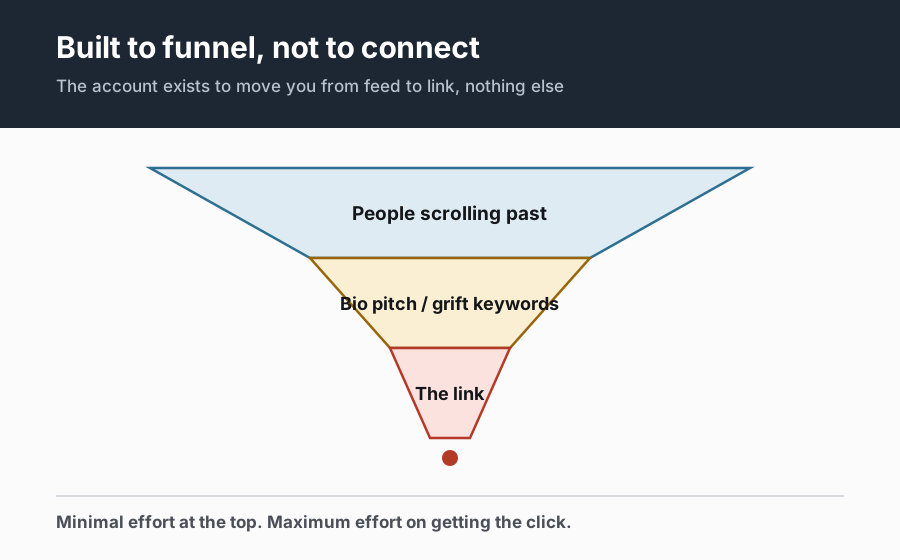
Everything about this type of account is stripped down to whatever's needed to get someone to click through and nothing more. A real profile photo costs effort and doesn't matter if the account only exists for a few weeks before it gets banned and replaced. A thoughtful bio doesn't matter — a pitch does. Genuine conversation doesn't matter — volume and reach do, which is why these accounts often lean on the same follow-heavy, low-reciprocity growth pattern you'd see from a pure growth-hacking account, just aimed at a promotional payload instead of vanity metrics.
The pattern tends to show up as a cluster of small, individually minor things that add up:
A profile that's clearly minimum-viable — default avatar, blank or link-only bio, a handle that ends in a long string of random digits, the kind of thing that happens when an account is generated in bulk rather than set up by a person who cares what it looks like.
Bio or post language that reads like an ad — crypto, affiliate, "get rich," engagement-bait phrasing — rather than anything resembling a personal voice.
The accounts around it looking thin too. Followers with default avatars and no posts, or accounts amplifying it that themselves look inauthentic — because these operations are rarely a single account working alone.
Why this pattern exists at all
Setting one of these accounts up costs almost nothing, and the whole model is a numbers game — spin up a hundred, or a thousand, aim them at a crypto scheme or an affiliate link, and even a tiny conversion rate off real, unsuspecting people pays for the operation many times over. There's no reason to invest effort in making any individual account convincing, because the strategy has never depended on any one account fooling anyone for long. It depends on volume, and on the fact that a lot of people scrolling past won't stop to check who's actually behind the pitch in their feed.
The most extreme, well-documented version of this playbook is the "pig-butchering" scam — fake profiles built specifically to cultivate a relationship before steering the target toward a fraudulent crypto investment. Researchers who've studied how these operations are actually run describe a systematic, almost scripted set of psychological and communication tactics designed to build trust before the ask (Oxford Academic, Journal of Cybersecurity, "Fake it till you make it"). These operations run at real industrial scale — entire scam compounds in Cambodia and Myanmar reportedly run large numbers of fake profiles simultaneously, with the accounts themselves functioning as disposable, low-effort front ends for the actual scam apparatus behind them (Wikipedia, pig butchering scam).
How BotShark spots it
No single thing here is damning by itself — plenty of real people have a blank bio or haven't gotten around to a profile photo. What we're actually weighing is the combination: profile minimalism, promotional or scammy language, and — where we can see it — whether the account's own network looks inauthentic too, meaning the followers and amplifiers around it show the same thin, default-avatar pattern rather than looking like a normal mix of real people. That last part matters a lot, because a real person with an unfinished profile doesn't usually have a follower list that's disproportionately fake.
What to do if you spot one
Don't click the link, basically. If an account matches this pattern, treat anything it's promoting as unverified at best and a scam at worst — these operations exist specifically because clicking through and trusting the pitch is exactly the behavior they're optimized to produce.