5 July 2026 · BotShark Team
The "American" account that keeps posting at 4am Eastern
A fake-location persona claims Texas or New York in the bio while posting at hours that fit somewhere else entirely. Bios lie for free; sleep schedules are hard to fake.

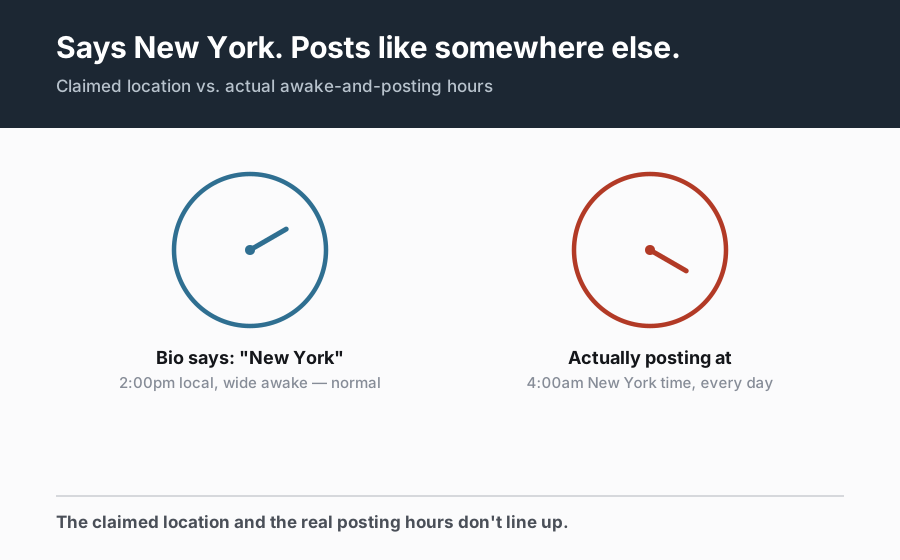
Anyone can type "Texas" or "New York, USA" into a bio field. It costs nothing and nobody checks it. What's much harder to fake convincingly is a sleep schedule — because unlike a bio, an account's actual posting hours, tracked over weeks, form a pattern that's genuinely difficult to fabricate on purpose without noticing the mismatch yourself. When that mismatch shows up, we call it a fake-location persona: an account presents itself as based somewhere — usually the US — but its actual awake-and-posting hours line up far better with a completely different part of the world.
What it's actually doing
Every real person has a rough daily rhythm shaped by where they actually live — awake and posting during their normal waking hours, quiet during the part of the day when they're asleep. That rhythm is honest in a way a bio field isn't, because it's a side effect of biology, not a claim someone typed in once. Academic researchers building bot-detection systems around the 2020 US elections leaned on exactly this: human accounts reliably show a diurnal, day/night posting pattern, while automated accounts tend to post on a non-uniform schedule shaped by whatever job scheduler or API constraint is actually running them, not by when a human body wants to sleep (arXiv, "Identification of Twitter Bots Based on an Explainable Machine Learning Framework: The US 2020 Elections Case Study").
This tends to show up as:
A bio location that doesn't match the schedule the account's own posting history implies, once you look at when it's actually active versus quiet across enough days to see the real pattern.
Specifically, an account presenting as American whose awake-hour pattern fits a non-US timezone noticeably better than a US one — a common enough shape that it's worth checking for on its own.
Why this pattern exists at all
A lot of coordinated or commercially-operated account networks are run by teams based somewhere other than the audience they're targeting — which makes sense economically, since operating a large batch of accounts is cheaper wherever labor is cheaper, regardless of who the accounts are pretending to talk to. Firms that specialize in detecting this kind of automation at scale describe timezone and location spoofing as one of the more persistent tells precisely because it's a mismatch between what an operator claims and what their infrastructure and behavior actually do — the persona can say anything, but the underlying activity pattern is much harder to fully disguise (Blackbird.AI, "Bots and Ghosts: Detecting Automation and Location Spoofing at Scale"). The persona needs to claim a location the target audience will trust or relate to, but the humans actually typing the posts are working on their own local clock, not the clock of the place the account claims to be from.
How BotShark spots it
We build a picture of when an account is actually active across enough days to see a real pattern, then check whether that pattern fits the location it claims better than it fits somewhere else. A profile claiming a US location whose posting hours line up much more naturally with, say, a European or Asian working day is a specific, fairly hard-to-fake mismatch — not proof on its own, since travel and odd sleep schedules are real things people have, but a meaningful data point, especially alongside other signals.
What to do if you spot one
Don't take the stated location, or anything that depends on it — local relevance, claimed lived experience, "as someone from X, I can tell you" framing — at face value. If the account's actual behavior doesn't match where it says it's from, the identity in the bio is doing persuasive work it hasn't earned.