4 July 2026 · BotShark Team
The account that keeps saying what another account just said
A coordinated campaign isn't one odd account — it's a dozen different handles posting near-identical text within minutes of each other. One of the clearest bot signatures there is, because it's genuinely hard to fake by accident.

Here's a pattern that's less about any single account's behavior and more about what happens when you look at several accounts side by side: near-identical wording, showing up from different handles, within a tight window of time. Not "similar opinions," which real people obviously share all the time — actually similar phrasing. Same odd word choice, same structure, sometimes literally the same sentence, posted by accounts that supposedly have nothing to do with each other. Researchers who track this call it coordinated inauthentic behavior, and we shorten it to a coordinated campaign account — unlike a lot of the other bot patterns, it's genuinely hard to explain away as coincidence once you see it clearly.
What it's actually doing
A single account copying and pasting text isn't unusual — memes and quote formats spread that way all the time. What makes this pattern different is the coordination: multiple accounts, posting the same or near-identical content, close together in time, in a way that looks less like organic sharing and more like several accounts pulling from the same script or the same instruction sheet.
It shows up in a few related shapes:
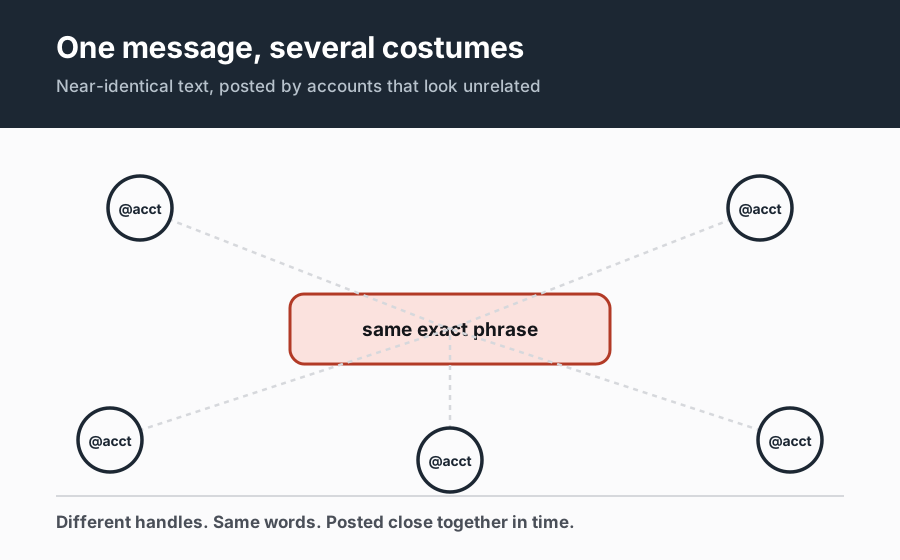
Near-identical post text appearing from more than one account you've looked at, close together in time — the digital equivalent of two people reciting the same line.
The same duplicated content showing up across several different handles, not just two, which starts to look less like a coincidence and more like a distributed campaign.
Post or bio text that matches known phrases from documented bot-farm and propaganda operations — patterns researchers and platforms have already caught and catalogued elsewhere.
Several accounts routing their links through the same destination — different accounts, same funnel, which is a strong sign they're being operated, or at least directed, by the same entity.
Why this pattern exists at all
Coordinated posting is how you make a narrative look bigger than the number of people actually behind it. If ten accounts all post the same talking point within the same hour, anyone scrolling past sees ten independent-looking confirmations of the same claim — which is a lot more persuasive than one account saying it once, even though it's really one message wearing ten costumes. This is the mechanism behind a lot of what gets called astroturfing: manufacturing the appearance of grassroots agreement using accounts that are, in reality, all pointing the same direction on purpose.
Graphika and the Stanford Internet Observatory jointly investigated exactly this kind of network after Twitter and Meta removed a set of accounts for coordinated inauthentic behavior, finding an interconnected web of accounts across eight different platforms running deceptive, coordinated messaging campaigns over almost five years — not one operation, but a series of overlapping ones using the same coordination playbook (Graphika / Stanford Internet Observatory, "Unheard Voice"). Academic researchers surveying this space more broadly have found coordinated posting to be one of the most consistent, detectable signatures across totally different platforms and political contexts, precisely because near-simultaneous, near-identical content is so much harder to produce by accident than any single account's behavior is (arXiv, "Detection and Characterization of Coordinated Online Behavior: A Survey").
How BotShark spots it
This is one of the few patterns where we're not just looking at one account in isolation — we're comparing it against other accounts you've scanned, looking for near-identical text appearing close together in time, or link destinations that keep showing up across supposedly unrelated accounts. We also check post and bio text against a maintained list of phrases known to come from documented bot-farm and coordinated-campaign operations, which catches cases where the coordination happened somewhere else, before the accounts ever crossed paths with you.
What to do if you spot one
Treat the whole cluster as one voice, not several. If multiple accounts are saying the same thing at the same time, the fact that ten people appear to agree with a claim tells you nothing about whether ten independent people actually do — it might just mean one operator wrote it once and posted it ten times.