3 July 2026 · BotShark Team
The account built to publish, not to talk
A broadcast operator posts huge volume, but the second you look for an actual conversation, there isn't one. This type isn't hiding — it's just not built for two-way engagement.

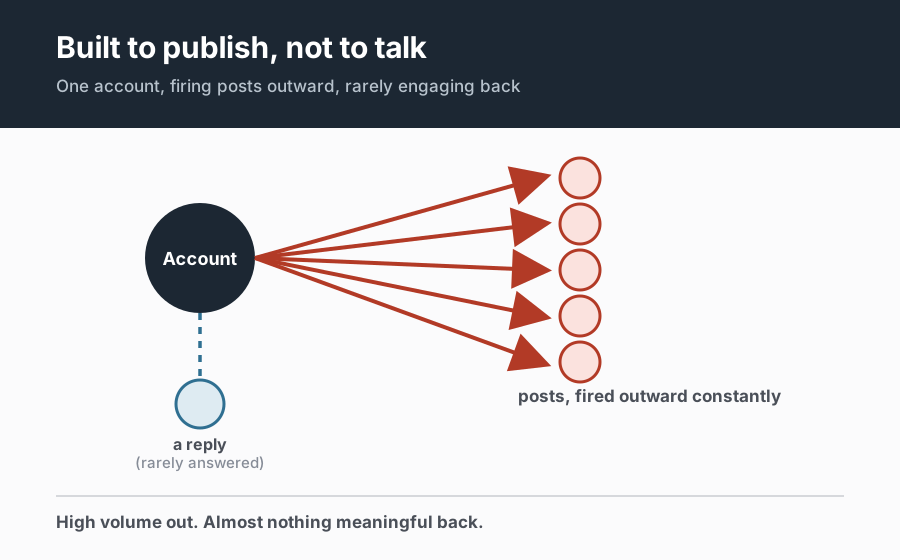
Some accounts post an enormous amount and clearly aren't trying to have a conversation with anyone. They fire out post after post, sometimes dozens or more a day, and if someone replies, they might get a reply back to the first comment or two on a thread and then... nothing. The account's already moved on to the next post. It's not rude, exactly — it's just not built to talk. It's built to publish. Analysts who track this pattern call it a broadcast operator, and it sits right next door to legitimate broadcast media accounts, which is exactly why it's one of the trickier types to call correctly.
What it's actually doing
A genuine news wire or media account behaves a lot like this too — high volume, mostly one-directional, replies mostly ignored, because their actual job is publishing headlines and links, not chatting with individual followers. So the interesting question isn't "does this account behave like a broadcaster," it's "does this account have any actual reason to be one." A verified newsroom, sure. An account with no stated affiliation, a generic name, and a bio that doesn't explain why it's pushing out fifty posts a day? That's a different story.
The shape usually includes:
Posting volume that's genuinely high relative to a normal account, sustained over time rather than a single viral day.
A one-way engagement style — replies happen, if at all, only to the first few comments on a thread, then the account moves on and never circles back.
Sometimes paired with an account that's surprisingly new for how much history it's already built up, which is a strange combination for an organic account and a very normal one for something spun up specifically to publish at scale from day one.
Why this pattern exists at all
Publishing at volume is a strategy in its own right, separate from trying to look like a real conversational person. If the goal is to flood a topic, a hashtag, or a search result with a particular framing, you don't need engagement — you need volume and reach, so that anyone searching or scrolling runs into your framing repeatedly.
This has been documented at genuinely industrial scale. Russia's Internet Research Agency, the best-studied state-run operation of this kind, reportedly employed 300 to 400 people working in shifts specifically to keep a constant stream of posts going, treating output like a production quota rather than a conversation (Wikipedia, state-sponsored Internet propaganda). The economics haven't gone away — they've just gotten cheaper. Researchers at Graphika have found that modern propaganda campaigns increasingly flood the internet with low-quality, AI-generated posts that get very little real engagement, because the campaign's goal was never conversation, it was saturation (NBC News, "Some of the largest online propaganda campaigns are using 'AI slop'").
It's also, worth saying plainly, exactly what a legitimate news organization's account looks like from a pure behavior standpoint — which is why this type is judged in context, not in isolation. The same statistical shape means something very different depending on whether there's a real newsroom behind the account or nothing at all.
How BotShark spots it
We look at the combination of high sustained volume with a distinctly one-way reply pattern — engaging with the first few comments on a thread and then dropping off, rather than actually holding a conversation. On its own that's not enough, because it's also how real media accounts behave, so we weigh it against other signals — account age relative to how much it's already posted, whether the content reads as duplicated or templated rather than genuinely varied reporting, and whether the account otherwise carries the hallmarks of an actual publisher versus a content-flooding operation dressed up to look like one.
What to do if you spot one
Check whether there's a real, identifiable publisher or brand behind it before deciding what this pattern means. If there is, this is probably just how a busy media account behaves and isn't cause for concern on its own. If there isn't — no clear affiliation, no history that explains the volume — treat the sheer amount of content as a red flag on its own terms: something is optimizing for saturation, not conversation, and it's worth asking why.