2 July 2026 · BotShark Team
The account that sat quiet for a year and then suddenly woke up
A bought or repurposed account wasn't born a bot — it was bought. A real, aged, previously-dormant profile gets picked up, handed to a new operator, and put back to work. Here's how to spot one that's changed hands.

Not every bot account was born a bot. A meaningful chunk of the ecosystem is made up of accounts that used to be something else — a real person's abandoned profile, or an account created in bulk during a known farming wave, sitting dormant for months or years — before someone picked it up and put it back to work. We call this a bought or repurposed account, sometimes shortened to a "sleeper," and it's a little different from the other types on this list because the tell isn't really about what the account does now, it's about the shape of its history.
What it's actually doing
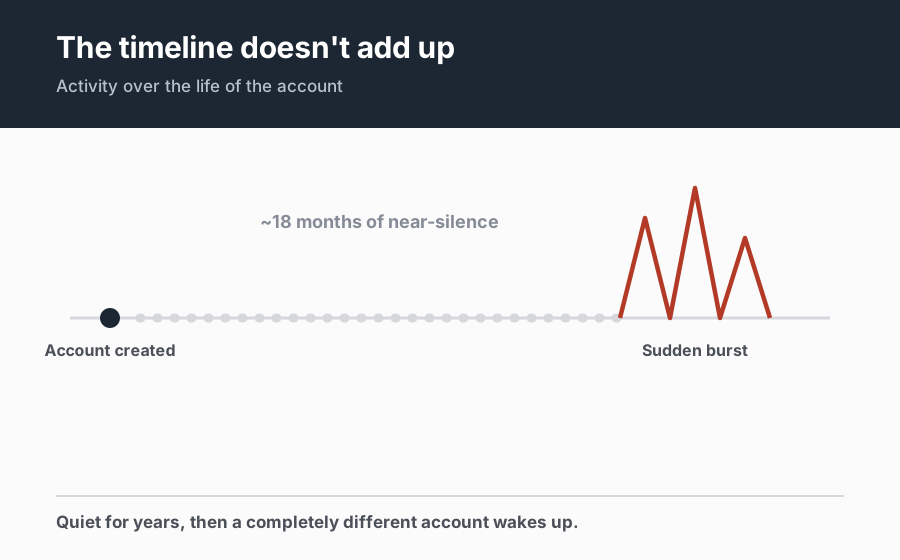
An account like this usually shows a strange discontinuity somewhere in its timeline. Long quiet stretches, sometimes a year or more of nothing, followed by a sudden burst of activity that looks nothing like whatever came before it — different topics, a different posting rhythm, sometimes an entirely different personality if the bio or display name changed too. Or it follows the opposite shape: an account created during a specific, documented window when bulk account registration was unusually high, sitting mostly unused until it's needed.
The reason this matters is straightforward — an aged account carries something a brand-new one doesn't: history, a follower base, and the platform's own trust signals built up over time simply by existing for a while without getting flagged. Buying or reactivating one of those skips past the "new account" suspicion that a freshly created bot would immediately run into.
The pattern tends to show up as:
Creation timing that lines up with a documented period known for bulk account registration or farm activity, rather than being spread out randomly like organic sign-ups.
A sudden burst of new activity, or a fast follower spike, after a long quiet period — the digital equivalent of an account waking up.
A posting pace, once active, that's well beyond what a person could sustain by hand — sometimes dramatically so.
A username that's changed, sometimes more than once, which is a common step when an account changes hands and gets rebranded for its new purpose.
Why this pattern exists at all
There's a real, documented gray market for exactly this — buying aged, previously-real accounts specifically because they skip the scrutiny a brand-new account attracts. Security researchers who study identity manipulation on social platforms describe this as part of a broader toolkit: reusing an account with real history is cheaper and lower-risk than standing up a new one that has to earn trust signals from zero (Gen Digital, "Identifying Sockpuppet Accounts on Social Media Platforms"). Academic research into fake-identity accounts more broadly has found that operators controlling multiple identities tend to reuse and rotate the same pool of accounts across campaigns rather than constantly building from scratch — a resourcing choice that shows up as exactly this kind of dormant-then-active pattern once you look at an account's full timeline instead of just its current behavior (Stanford / WWW 2017, "An Army of Me: Sockpuppets in Online Discussion Communities").
How BotShark spots it
We look at the account's whole timeline for discontinuities — a long dormant stretch followed by a sharp change in behavior, creation timing that matches a known bulk-registration window, a follower count that jumped unusually fast relative to where it sat a week earlier, or a username that's been changed, all considered together rather than any one of them alone. It's genuinely a different kind of signal from most of the other bot types here — less about catching an account doing something suspicious right now, more about noticing that its history doesn't add up to one continuous, plausible person.
What to do if you spot one
Weigh the account's current behavior more than its apparent age or follower count. The whole point of this pattern, from the operator's side, is to borrow legitimacy from an account's history — don't let a follower number or a multi-year creation date do the vouching for you if the timeline underneath it doesn't actually hold together.